

Frequently Asked Questions
Frequently Asked Questions
Is this ethical?
Yes, the PRECARE study has been reviewed and approved a NSW health ethics committee
Is this cost effective?
Published health economic analysis on the provision of ECPR has demonstrated that despite the expense of the procedure and hospital stay, patients who do survive go on to have long and productive lives. The PRECARE medical team do not only provide ECPR, they also provide advanced, hospital based interventions for patients in cardiac arrest, allowing pre-hospital teams to focus on excellent ALS provision and not be disrupted with transportation
What is ECMO/ECLS/ECPR?
There is a lot of terminology surrounding extracorporeal life support (ECLS), essentially, it is a form of peripheral heart bypass. When ECLS is used for patients in cardiac arrest it is known as ECPR.
A large cannula is placed via the femoral vein into the inferior vena cava where the patient’s blood is drained into a membrane oxygenator, that blood is oxygenated and carbon dioxide is removed. Blood is then pumped back into the patient via a cannula sitting in the femoral artery, returning that oxygenated blood to the aorta. Intellectually, it makes sense- technology that can bypass the heart and provide adequate perfusion to the brain and other vital organs is the perfect treatment for someone in cardiac arrest.
ECPR essentially stops the clock allowing time for the cause of the cardiac arrest to be treated, often that involves interventional coronary angiography in the hospital. A cardiac arrest will not stop until the cause of the arrest has been treated.
Who makes up the PRECARE team?
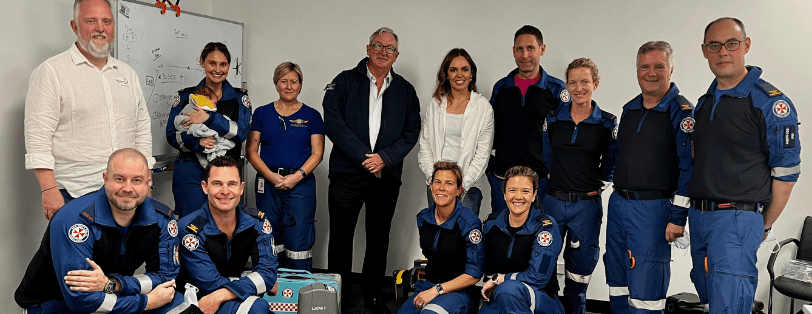
The PRECARE team is composed of 2 senior aeromedical specialist doctors and a critical care paramedic. This team has been trained specifically to provide ECPR in the prehospital environment for the trial. The team is based in Homebush, using a rapid response vehicle.
What is the cost of doing the trial and how is the trial supported and funded?
The cost of consumables to perform ECPR are approximately $10,000 per patient. This does not include a patient’s hospital stay. The trial is sponsored by NSW Ambulance and supported with in-kind support by Westmead Hospital and RPA Hospital. The trial is also supported by GE Healthcare, Australian Blood Management. The trial received a Greenlight Foundation research grant and a NSW Health research grant.
 PRECARE